The policy choices America makes in the next few years will determine whether we lead or follow in the artificial intelligence (AI) era. Policymakers at all levels must keep five principles front-of-mind to ensure America wins.
- America Is In A Neck-And-Neck Race With China, And Our One Advantage Is Eroding
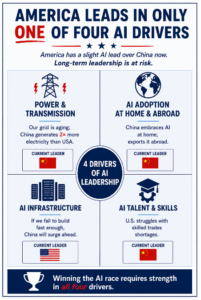
America holds the advantage in AI right now. But long-term leadership rests on four drivers — energy, talent, adoption, and compute — and we lead in only one of them. Compute (data centers, chips, and AI models) is where America is strongest, but that edge is eroding from three different directions at once.
- China is closing the model gap. Its top models now compete head-to-head with American ones despite having far fewer advanced chips. Beijing is also on pace to nearly double its data center capacity by 2030.
- We are blocking our own buildout. There are 127 active state and local data center moratoriums and restrictions across 40 states. More than 75 data center projects worth $130 billion were blocked or delayed in the first three months of 2026 alone.
- A 50-state sea of red tape. States have introduced more than 1,800 AI-related bills in 2026. No country wins this race running 50 different playbooks.
- The World’s Future Will Be Shaped by American or Chinese AI
Technology is not neutral. It carries the values of whoever builds it. China’s AI is built for censorship and control. America’s is built for freedom and opportunity.
As China embraces AI at home, it is also working aggressively to make its technology stack the global default: exporting infrastructure to developing nations, releasing open-weight models that undercut Western alternatives, and pushing to write pro-China international governance standards the rest of the world will follow. Every country that adopts China’s stack inherits its assumptions about surveillance, speech, and state control. This is why it matters which country builds the future.
- America Must Have A Bias To Build This Infrastructure
We built railroads that connected a continent. We built interstate highways that unlocked commerce and mobility. We built the internet that became the backbone of the modern economy. At every one of those moments there were real community concerns, real debates, and real opposition. We addressed those concerns without losing our determination to build. That approach made America stronger, wealthier, and the world’s innovation leader.
The AI era has a physical foundation of data centers, energy generation, and electricity transmission, but we are in a spirited debate over whether we should build this infrastructure at all. America has always won by building. AI should be no different.
- AI Infrastructure Is Essential To Our Security, Competitiveness, And Our Communities
This is not an abstract technology debate. What gets built or blocked determines three concrete outcomes.
- National security. AI shapes intelligence analysis, cyber defense, logistics, and more. A nation that cannot power and compute at scale cannot defend itself at scale.
- Economic competitiveness. AI is the general-purpose technology of this century, driving productivity for small businesses, manufacturers, health care, agriculture, and energy. Whoever leads in AI will leads in nearly everything downstream of it.
- Community strength. Data centers are powerful engines of local economic growth: construction work, permanent jobs, local suppliers, and lasting tax revenue. An independent Brookings analysis of counties receiving their first large data center found long-term employment rose 4 to 5 percent and wages rose 3 to 4 percent, gains that hold well past the construction phase.
- To Win, America Needs A Single Playbook
America doesn’t have an innovation problem: We have a policy alignment problem. We need a single playbook that allows our three major actors to do what each does best.
- The private sector should innovate, compete, and deploy AI.
- The federal government should set a light-touch unified AI framework, establishing guardrails that earn public trust while knocking down barriers to innovation.
- The states should invest in energy generation, transmission, workforce, and local adoption.
Specific actions federal and state policymakers can take include:
- Codify the American AI Action Plan into law. One national playbook that survives changes in administration and stops the state patchwork before it hardens.
- Boost power generation with an all-of-the-above approach: nuclear, natural gas, renewables, storage.
- Modernize/secure the grid. Streamline permitting, expand transmission, harden against cyber threats.
- Onshore energy supply chains. More gas turbines and transformers should be made here.
- Freeze over-reaching state AI laws. A patchwork of laws slows innovation and undermines startups.
- Secure critical minerals. Domestic rare earth processing, beyond China’s chokehold.
America Must Act With Urgency
Local concerns about AI infrastructure are valid and need to be addressed in ways that create win-win outcomes. But high-profile public protests are not the whole picture, and there is more room to act quickly and responsibly than the headlines suggest. Recent polling by American Edge Project found:
- Voters want expanded energy capacity. 77 percent of all voters agree America needs more electricity to meet growing demand.
- Voters say AI’s higher energy use is worth it when the benefits are clear. Strong majorities of voters want AI’s health care breakthroughs and cures, economic growth, stronger national security, and American competitiveness in education.
- Voters want ratepayer protections. Most support a Ratepayer Protection Pledge requiring technology companies to help cover the costs of new capacity while keeping household electricity affordable.
In short, voters are not saying no. They are setting practical terms: build more energy, show the local benefit, and protect families. Meet those terms and not only do we win the debate, but America wins the future.
AI can be our modern-day moonshot: a moment that accelerates innovation, delivers real benefits to working families, and secures American leadership for the next 50 years. But we can’t wish our way to leadership. We must build.