Jobs, affordability, and competitiveness beat regulation
By Doug Kelly, American Edge CEO
In Washington and in the media, there’s a growing narrative that voters are clamoring for tougher regulation of technology and artificial intelligence (AI). That narrative is false – and the data is clear.
As the 2026 midterms approach, Americans are focused on the same fundamentals they always are: lowering the cost of living, strengthening jobs and wages, and protecting the country’s economic and national security. They are not asking for a new wave of tech and AI regulation that risks slowing American innovation at a critical moment.
American Edge Project’s (AEP) New Polling: Voters Focused on Jobs and Inflation, Not Tech Regulations
New polling from AEP underscores this reality. More than nine in 10 likely midterm voters say their top priorities are economic issues—things like inflation, jobs, healthcare affordability, and government corruption. Regulation of AI and U.S. tech companies ranks near the bottom of voter priorities across Democrats, independents, and Republicans alike.
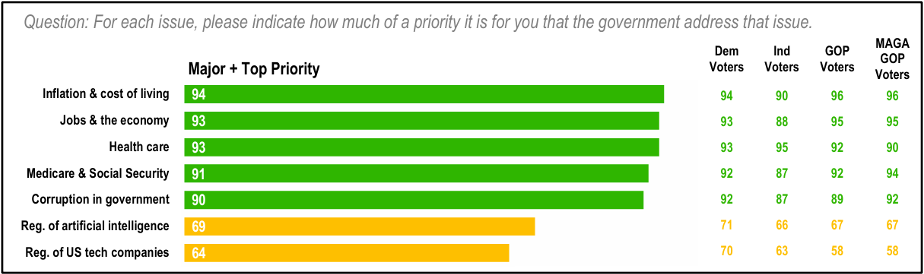
This finding is a warning sign for policymakers who misread the electorate. Candidates who make regulating AI a central campaign message are out of step with what voters actually care about, and that carries real electoral risk.
In fact, roughly one-quarter of likely voters would cross party lines to support a candidate focused on lowering costs over a same-party candidate focused on further regulating AI, and more than 70 percent of likely independent voters would back the lower-my-costs candidate. Voters are clear: affordability and economic growth come first.
Voters Also Understand the Growing Danger of China’s Tech Strength
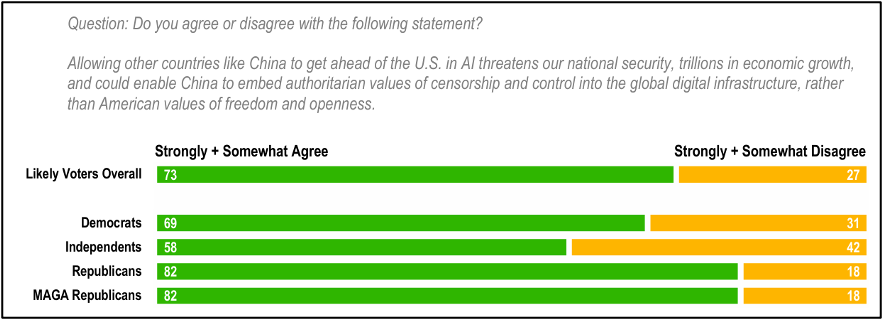
At the same time, Americans recognize the high stakes of the global AI race. Across party lines, large majorities of voters are worried about China and other foreign adversaries surpassing the United States technologically, conducting cyberattacks on critical infrastructure, and engaging in espionage against U.S. interests. Most voters (chart below) agree that if China pulls ahead of the U.S. in AI, it would threaten national security, economic growth, and America’s ability to shape global values around freedom and openness rather than censorship and control.
POLITICO Polling: Data Center Construction is Not a Deciding Factor for Voters
Additionally, POLITICO’s Public First polling shows that voters don’t view data center growth as a determining factor for how they vote. Roughly one-third of respondents said a candidate’s support for local data center construction would have no impact on their vote for U.S. Representative, regardless whether that candidate was a Republican or Democrat. While the issue is not a decisive campaign driver for most, voters do support local data center construction by nearly a 10-point margin (37 to 28 percent).
This is because voters understand that data centers are engines of real economic impact in communities across the country. According to America’s AI Surge: Powering Investment, Jobs and Growth in Every State, the nearly 2,800 data centers currently planned or under construction are expected to generate an estimated 4.7 million temporary construction-related jobs, 697,000 permanent operating jobs, and about $27 billion in new state and local tax revenue over the next decade – funding priorities like teacher salaries, police and fire protection, and other essential local services.
The Bottom Line: Voters Understand What’s at Stake in the AI Race
Together, the findings from these two polls undercut the narrative that data centers are a political liability. While they may not be AI experts, voters understand that data centers are the factories of the AI era – and that, like manufacturing, they depend on power, compute, talent, and infrastructure.
Voters want elected officials who advance their own prosperity, their communities, and the country as a whole. They want leaders focused on economic relief, competitiveness, and national security, not policies that regulate America into second place. Because this isn’t just a tech race: it’s a race to protect our values, our security, and our future.