By Doug Kelly, CEO, American Edge Project
America is in a $7 trillion race with China for global AI leadership—and our long-term position is at risk.
Our newly released Visual Guide to the U.S.–China AI Race lays out the evidence for this claim clearly and graphically: across the top four pillars of AI strength, China is outpacing us in energy, talent, and adoption, and aggressively working to offset the advantages we still hold today in compute.
AI leadership isn’t simply about innovation. It’s about national security, economic strength, and which country’s values will underpin the world’s digital infrastructure. And right now, America is not positioned for long-term success. But this is a solvable challenge—if we invest, build, and move with the urgency of a modern-day moonshot.
Below are the key findings from the Visual Guide.
1. Energy: China’s Biggest Advantage in the AI Race
AI runs on massive amounts of electricity and China has made energy abundance a national strategy.
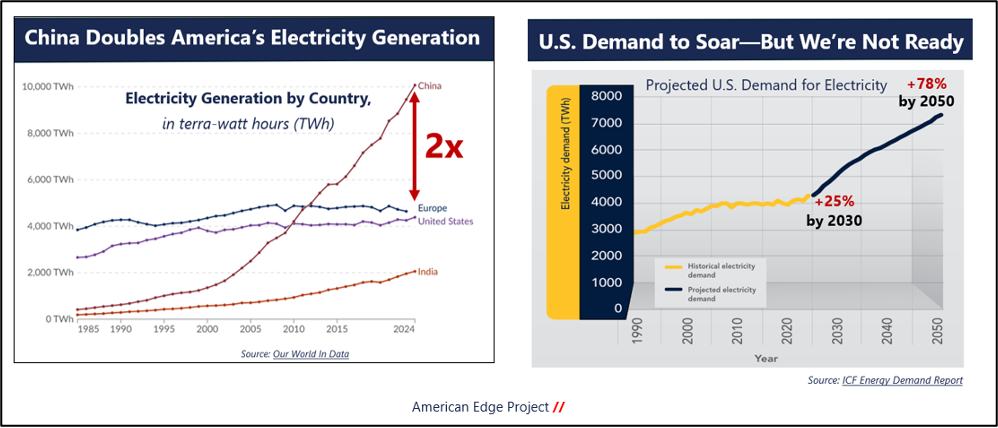
- China generates twice as much electricity as the U.S.
- It is investing $300 billion more in energy this year than America.
- It will add 60 percent more power by 2040.
In fact, experts say China considers AI’s large electricity demands as a “solved problem.”
Meanwhile, the U.S. faces a projected +78 percent surge in power demand driven by AI, reindustrialization, EVs, and more, all hitting a grid never built for this moment.
2. A Grid Crisis That Could Throttle American AI
Decades of underinvestment have left the U.S. with a fragmented, outdated, unreliable grid.
- 100-fold increases in power outages by 2030.
- Transformer wait times: two to four years.
- Gas turbine wait times: up to seven years.
We cannot lead in AI without the power to run it. Without energy, even the smartest chips sit in the dark.

3. Compute: America’s Advantage Is Eroding
Today, the U.S. controls approximately 75 percent of global AI compute and maintains a three-to-one chip advantage over China. But this edge is narrowing.
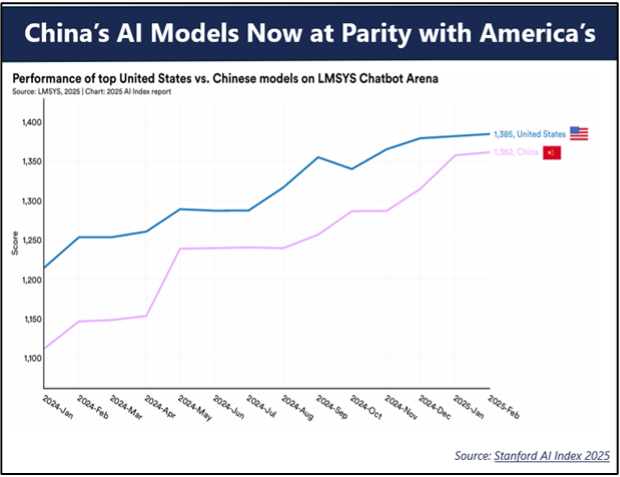
China is rapidly building massive graphics processing unit (GPU) clusters and has now reached near parity with top U.S. models in reasoning, math, and coding benchmarks. As China scales up powerful AI computing nationwide, the gap between us will continue to close.
4. Talent: China Is Flooding the Zone as U.S. Faces Severe Shortages
AI is ultimately a talent contest, and America is falling behind. Not only does China produce 47 percent of high-level AI scientists (the top 20 percent), but it also graduates 27 million more STEM students per decade than the United States – that’s millions more people focused on AI research and applications.
Meanwhile, America faces a multi-million person shortage of workers in AI-related fields: plumbers, electricians, cybersecurity, semiconductors, advanced manufacturing, and mining. These are the very jobs that build, secure, and power our entire AI stack. If we don’t solve this gap soon, our long-term competitiveness will be damaged.

5. AI Adoption: China Is Moving Faster—at Home and Worldwide
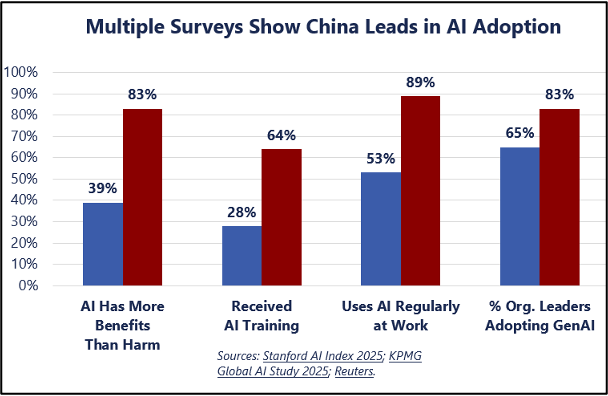
The country’s whose AI is most broadly adopted at home and in the rest of the world will be difficult to supplant. Nd by many measures, China leads the world in AI adoption:
- Nine in 10 workers use AI at work
- 83 percent of Chinese companies use generative AI vs. 65 percent in the U.S.
- China’s trust and workplace integration levels far exceed ours
Beijing is also exporting its AI models globally, systems engineered to censor, surveil, and shape information. If these models take root, they will threaten American values and democratic norms worldwide.
What America Must Do: America Can Win This Race
We’ve overcome challenges like this before and we can do it again. With smart, decisive action, the U.S. can secure enduring AI leadership. Here are the priority steps our Visual Guide identifies.
1. Codify and Fund President Trump’s AI Action Plan: This creates a durable federal AI strategy, prevents future policy reversals, and stops state-level overreach that can slow U.S. AI innovation.
2. Strengthen Power & Transmission Infrastructure: Accelerate “all-of-the-above” energy generation; onshore turbine and transformer production; modernize and secure the grid; streamline permitting and expand transmission.
3. Reinforce America’s AI Infrastructure: Maintain U.S. chip and compute advantage; secure critical mineral supply chains; enact a multi-year freeze on restrictive state AI laws; reject regulations that weaken innovation.
4. Build America’s AI Workforce: Launch a national AI talent initiative across government, industry, and higher education; scale workforce retraining programs; invest in K–12 AI and computer science education; expand high-skilled immigration pathways.
5. Accelerate AI Adoption at Home and Abroad: Promote AI literacy and a deep understanding of AI’s benefits to America’s working families; expand industry-led training programs; export American AI globally; give allies priority access to U.S. chips, models, and cloud services; counter China’s surveillance-laden AI exports.
Taken together, these actions form a clear blueprint for American AI leadership. If we move with purpose and urgency, the U.S. can unlock a new era of growth, discovery, and security—and ensure that the world’s digital future reflects freedom, openness, and American values. We’ve led before in space, in technology, and in science. We can do it again with AI. The choice is ours and the moment is now.
###