By Doug Kelly
America’s artificial intelligence (AI) surge is creating millions of high-paying jobs that don’t require a college degree – from plumbers, electricians, heating, ventilation, and air conditioning (HVAC) professionals, and energy workers to the skilled trades that build and maintain critical infrastructure.
Now add fiber and broadband technicians to that list. As The Wall Street Journal recently reported, the fiber-optic boom is one of the fastest-growing opportunities tied to AI and data center expansion. Fiber workers routinely earn $70,000-plus per year, with experienced drillers, linemen, and splicers making far more through overtime. Companies are raising wages five to eight percent, and demand is accelerating as broadband buildouts and data centers require millions of new miles of fiber nationwide.
But America’s AI opportunity is bumping against a hard constraint. The Wall Street Journal also notes that while 58,000 new fiber jobs are expected between 2025 and 2032, 120,000 workers are projected to leave the field, creating a 178,000-worker shortfall that is already slowing projects.
As we documented in the American Edge Project’s Visual Guide to the U.S.–China AI Race, this challenge isn’t isolated. The U.S. is already facing shortages of electricians (-251,000), cybersecurity professionals (-750,000), plumbers (-550,000), advanced manufacturing (-1,900,000), and other critical roles needed to power, secure, and scale AI (see graphic below).
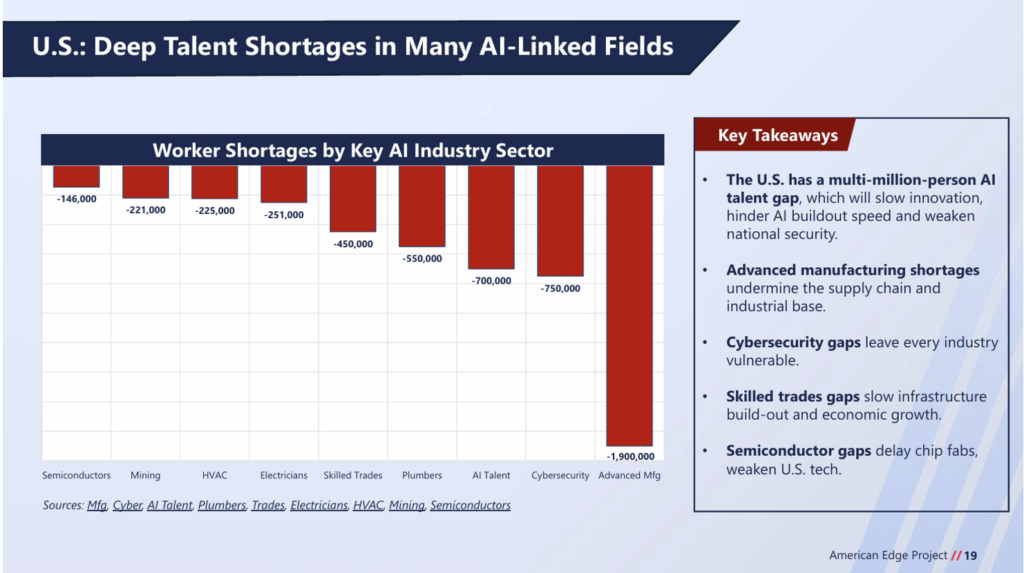
The stakes are high: While America has the technology, capital, and ambition to remain global AI leader, this race will largely come down to talent and speed. Can we train and deploy the workforce fast enough to build the AI era before China does?
This is where state legislatures can play a decisive role. Rather than mandating how AI models should work, state policymakers can help close the talent gap by:
- Expanding and modernizing skilled-trade pipelines, including apprenticeships, fast-track certifications, and partnerships with community colleges and high schools
- Aligning workforce funding with AI-era needs, from electricians and linemen to cybersecurity and advanced manufacturing
- Removing barriers to infrastructure buildout, so energy, broadband, and data center projects aren’t delayed by permitting bottlenecks
- Making it easier for workers to move and retrain, including license reciprocity and portable credentials across states
This is why states that treat AI as an economic opportunity – not a threat – will gain a clear competitive advantage in attracting industry, jobs, and investment capital. More companies are choosing locations based on whether a state has the talent pipeline to support growth over the next decade, not just short-term incentives. States that move fastest to train electricians, fiber technicians, cybersecurity professionals, and skilled trades will win near-term investment and lock in long-term growth, higher wages, and leadership in the AI economy.