
America has a long history of building the infrastructure that powered our future — from railroads to the interstate highway system to the internet. At each moment, there were real concerns and real debates. But we chose to build, and those decisions paid off in economic growth, national security, and global leadership.
Today, we face a similar moment, this time with artificial intelligence (AI).
Yet a recent Wall Street Journal report highlights a growing push in some states and communities to ban or delay new data center construction — the very infrastructure that powers AI. That would be a costly mistake, with lasting consequences for both our local economies and our national competitiveness.
The Value of AI Infrastructure to Our Country and Our Communities
Today’s American AI is powered by a physical infrastructure of thousands of data centers housed in all 50 states. These are the factories of the AI era. Without them, we do not get the innovation, the economic growth, or the national security advantages that come with leading in AI.
That leadership delivers three things:
First is national security. AI is already strengthening America’s ability to detect cyber threats, accelerate intelligence analysis, optimize military logistics, and maintain an edge over foreign adversaries. In a world where China is racing to dominate advanced technologies, falling behind is not an option.
Second is economic strength and societal benefits. AI is driving productivity across industries, helping small businesses compete globally, lowering costs, and unlocking new efficiencies. It is accelerating medical breakthroughs, improving diagnostic accuracy, and expanding access to personalized education tools for learners of all ages.
Third — and most immediate — is local impact. When a data center gets built in a community, the benefits are real, tangible, and lasting. Good-paying construction jobs come first, followed by millions in tax revenue flowing to school districts, road budgets, and public services. And the economic activity that follows a major facility investment ripples through local businesses for years. As the American Edge Project’s “50-State AI Scorecard” found, new data center development is projected to support 5.4 million temporary and permanent jobs nationwide, while generating $27 billion in state and local tax revenue over the next decade. These are not benefits that flow to distant shareholders. They stay at home where the facilities are built.
The High Cost of Saying No
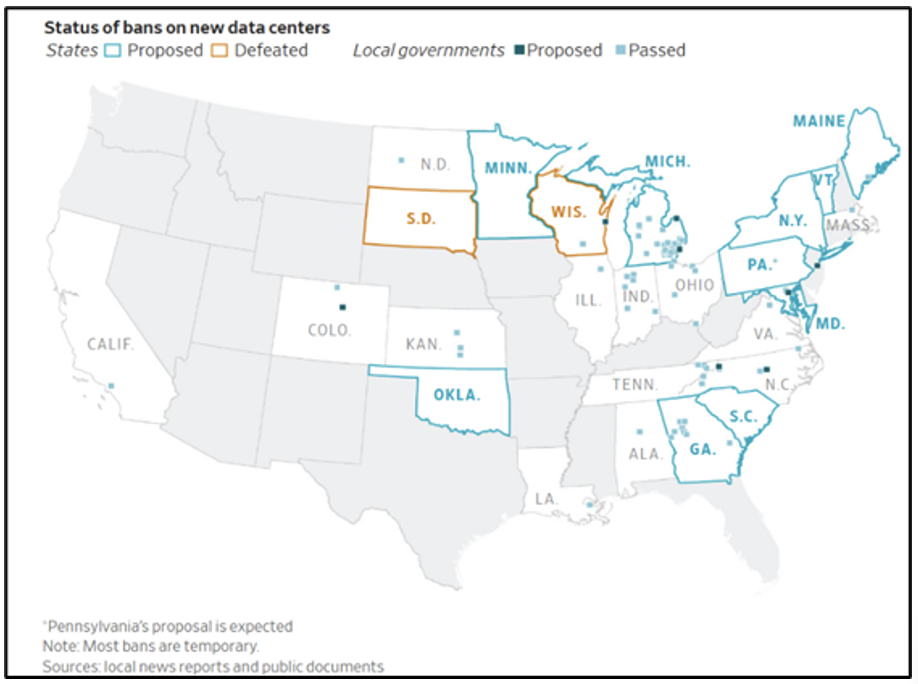 Data centers take years to plan and require long-term capital and certainty. When states pursue bans or moratoria, they are not slowing development. Instead, they are shifting jobs, tax revenue, and investment to other states and signaling they are closed for business.
For states currently debating restrictions, the costs are significant (data from 50-State AI Scorecard):
- Georgia: more than 552,000 jobs and $850 million in tax revenue at stake
- Pennsylvania: more than 356,000 jobs and $953 million in revenue
- Ohio: nearly 200,000 jobs and $266 million in tax revenue
- Minnesota: nearly 70,000 jobs and $177 million in revenue
- South Carolina: nearly 33,000 jobs and $163 million in revenue
Nationally, restricting data center growth would forfeit millions of jobs and billions in revenue while weakening America’s position in the global AI race. China is not debating whether to build this infrastructure. It is building at scale with a coordinated national strategy.
Building Responsibly, Not Walking Away
The most common concern driving opposition is electricity costs. But data centers didn’t cause the problem, they merely exposed it. For decades, utilities across the country underinvested in grid infrastructure. But now, data center builders are now helping finance new power generation, modernize transmission, and improve grid reliability. Done right, that investment strengthens the grid for every home and business in the community, potentially lowering costs. And data center developers who sign Ratepayer Protection Pledges are explicitly committing to cover the costs of the energy they use rather than passing them to consumers.
Critics also raise concerns about water use, community disruption, and the number of permanent jobs created. Those concerns are real, and in many cases data center builders are already responding by reducing water usage through closed-loop cooling systems, engaging directly with local officials, and structuring community benefit agreements that deliver long-term value.
Data centers also are uniquely efficient community partners, consuming relatively few public services like police and fire protection while contributing millions of dollars to the local tax base and funding the kind of infrastructure upgrades that benefit everyone. In Loudon County, Virginia for example (the area with the most data centers in the country) its estimated that roughly $1.37 billion will be generated from data center-related tax revenue by 2026.
But bans aren’t solutions and they don’t build our future. Communities should absolutely have a voice in how AI infrastructure is developed. But the goal should be to shape that development in ways that deliver local benefits and strengthen national capacity, not shut it down entirely.
Because this is a generational moment. And the states and communities that choose to build will be the ones that lead and reap the rewards.
###